


product description

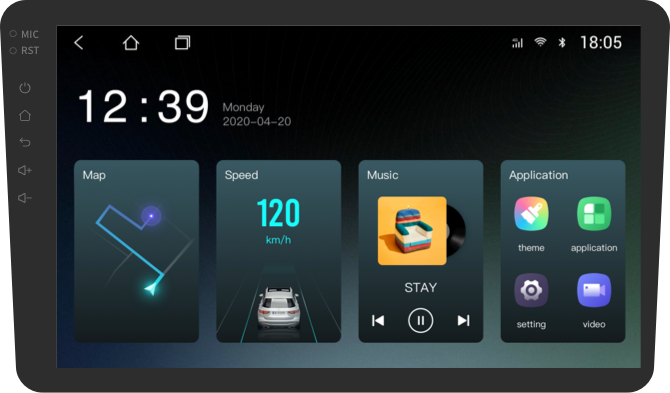
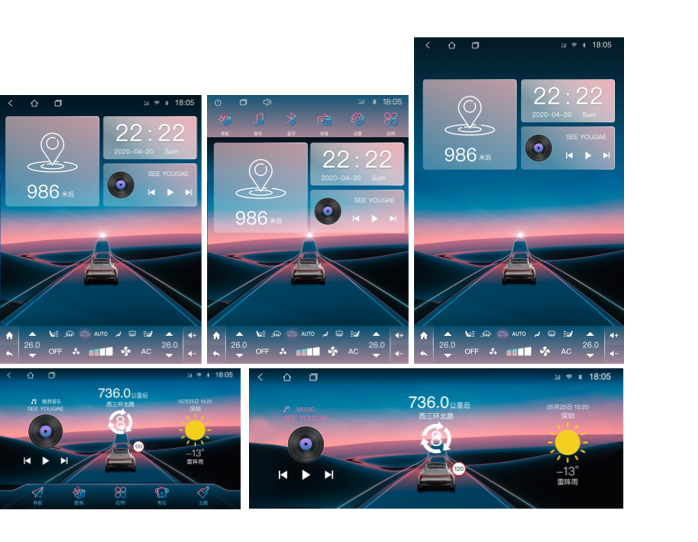
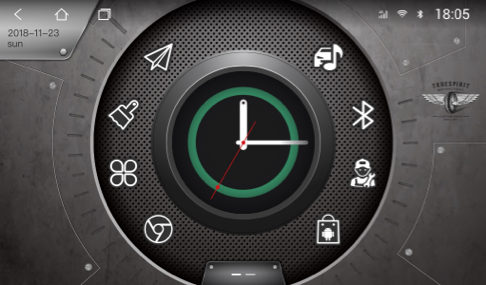
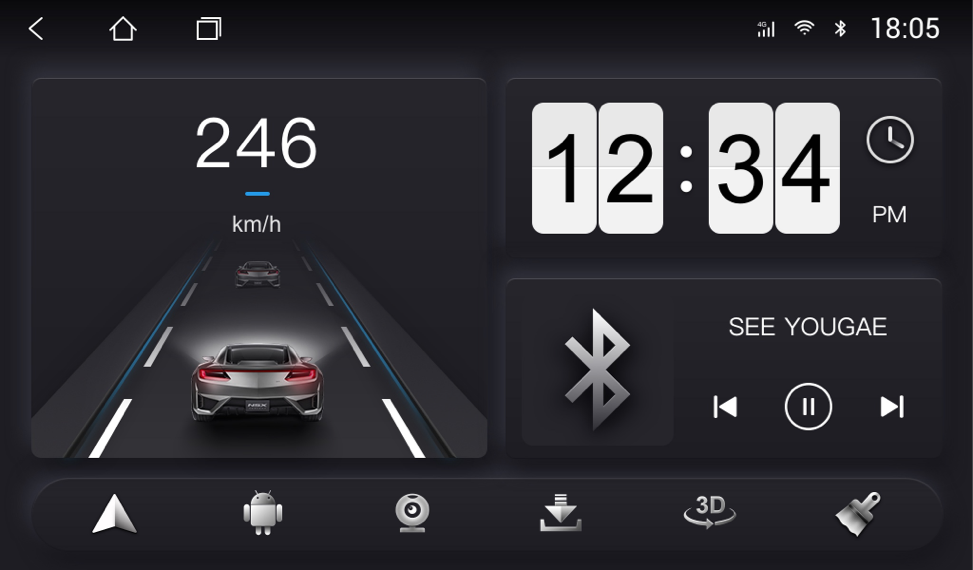
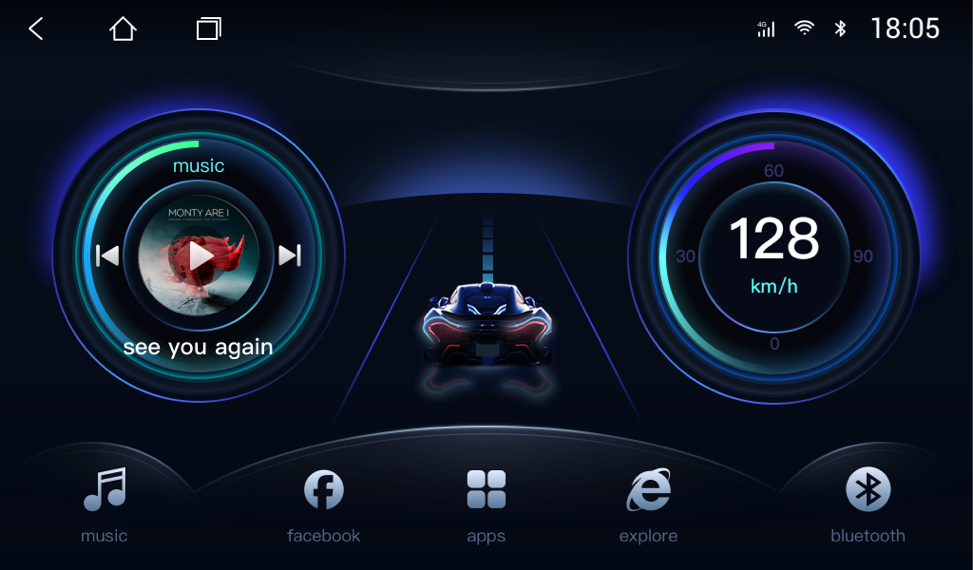
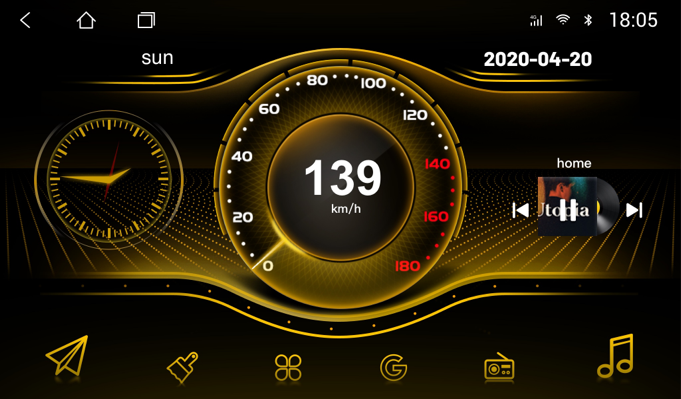
Not limited to a single theme framework, create 9 types of themes with different styles, there is always one that suits your taste!

Of course it's more than just looking good! When you drive on the road, you will find that the theme has rich dynamic effects, such as driving, instrumentation, ADAS, weather, etc., is it very interesting?

The shortcut icons on the desktop can be customized in style and function, and operate in the way you are used to!

product description
product description
Currently suitable resolutions are as follows:
Landscape contains: 1024x600、1024x768、1280x800、1280x480、2000x1200
Vertical screen includes: 768x1024、800x1280、1080x1920
If your car is different, it will use close resolution by default
Cars of Dingwei solution can use all the functions of the theme software, but some of the functions of cars of other solution providers are not available.

In addition to a single purchase, you can also


The fluorescent lights of the engineering lab flickered, casting long shadows over Leo’s keyboard. It was 3:00 AM, and the only sound was the hum of his CPU struggling against a massive stiffness matrix.
He was hunting for a ghost in his MATLAB script—a singularity error that kept crashing his structural simulation of a high-speed turbine blade. One wrong line of code, and the virtual metal shattered.
"Come on," Leo whispered, his eyes bloodshot. "Just converge."
He opened a file titled GlobalSolver_v9_FINAL.m. His fingers danced across the keys, refining the meshing parameters and tightening the boundary conditions. He wasn't just solving for displacement anymore; he was chasing the "hot" spots—those crimson zones of high stress that predicted catastrophic failure.
Suddenly, the progress bar turned green. The solver roared to life, iterating through the Newton-Raphson loops with rhythmic precision. The monitor erupted into a vibrant contour plot. The stress concentrations shifted, flowing like liquid fire across the 3D model, but staying just within the safety margin.
He’d done it. The code was elegant, efficient, and—most importantly—stable. Leo leaned back, the blue light of the successful simulation reflecting in his eyes. The turbine would hold.
main_thermal_FEAfunction [T_solution, time_vec] = transient_thermal_solver(... K, M, F, T_initial, dt, n_steps) % Transient thermal solver using generalized-alpha method % Inputs: % K - stiffness matrix % M - mass matrix % F - force vector % T_initial - initial temperature field % dt - time step % n_steps - number of time steps % Outputs: % T_solution - temperature field at each time step [n_nodes x n_steps+1] % time_vec - time vectorn_nodes = length(T_initial); T_solution = zeros(n_nodes, n_steps+1); T_solution(:,1) = T_initial; time_vec = zeros(1, n_steps+1);
% Newmark-beta parameters (for thermal transient) gamma = 0.5; beta = 0.25; % Average acceleration method
% Effective stiffness matrix (constant for linear problems) A = M + gamma * dt * K;
% Factorize for efficiency [L, U] = lu(A);
% Time marching for step = 1:n_steps time_vec(step+1) = step * dt; matlab codes for finite element analysis m files hot
% Right-hand side b = M * T_solution(:,step) + dt * (1-gamma) * (F - K * T_solution(:,step)) ... + dt * gamma * F; % Solve for next temperature T_solution(:,step+1) = U \ (L \ b); % Update for next step (if nonlinear, would need iterations) % For linear problems, direct solution works % Progress indicator if mod(step, round(n_steps/10)) == 0 fprintf('Transient analysis: %.0f%% complete\n', step/n_steps*100); end
end end
MATLAB .m files for FEA remain “hot” because they offer:
For production-scale problems, these codes are often prototypes later translated to compiled languages, but for learning, teaching, and small-to-medium research problems, MATLAB FEA .m files are still the gold standard.
To generate a solid piece for Finite Element Analysis (FEA) in MATLAB, you typically use the Partial Differential Equation (PDE) Toolbox to define a geometry, mesh it into finite elements, and solve for physical behaviors like stress or heat. Core Workflow for Solid FEA
A standard M-file for a 3D solid analysis follows these four primary steps:
Define Geometry: Create or import a 3D shape (e.g., a block or cylinder) using createpde and geometric primitives.
Generate Mesh: Use generateMesh to discretize the solid into smaller elements (typically tetrahedrons for 3D).
Specify Physics: Define material properties (like Young's modulus) and apply boundary conditions using structuralBC or structuralBoundaryLoad.
Solve and Visualize: Execute the solver and use pdeplot3D to see results like displacement or stress distribution. Example MATLAB Script (M-File) The fluorescent lights of the engineering lab flickered,
The following code generates a simple solid bracket, applies a fixed constraint on one side, and visualizes the resulting mesh.
% 1. Create a structural model for static solid analysis model = femodel(AnalysisType="structuralStatic", Geometry="bracket.stl"); % Replace with your file or create simple geometry % 2. Define material properties (e.g., Steel) model.MaterialProperties = structuralProperties(model, 'YoungsModulus', 210e9, 'PoissonsRatio', 0.3); % 3. Apply Boundary Conditions % Fix one face (e.g., face 3) model.BoundaryConditions = structuralBC(model, Face=3, Constraint="fixed"); % Apply a load to another face (e.g., face 2) in the Z direction model.BoundaryLoads = structuralBoundaryLoad(model, Face=2, SurfaceTraction=[0; 0; -1e6]); % 4. Generate Mesh and Solve model.Mesh = generateMesh(model, Hmax=0.01); % Generate elements results = solve(model); % 5. Visualize displacement pdeplot3D(model, ColorMapData=results.Displacement.Magnitude) title('Solid Piece FEA: Displacement Magnitude') Use code with caution. Copied to clipboard Essential Resources for M-Files
MathWorks File Exchange: You can find comprehensive solid mechanics environments like the A Finite Element Analysis Environment for Solid Mechanics which supports EDGE, QUAD, and HEX elements.
Educational Codes: For learning the underlying math, Ferreira's " MATLAB Codes for Finite Element Analysis
" provides scripts for solids and structures intended for graduate-level study.
CALFEM Toolbox: A popular open-source toolbox that requires users to manually assemble stiffness matrices, which is excellent for understanding the FEA process.
Truss2D.m)This is the "Hello World" of FEA. It’s hot because it introduces the direct stiffness method without the complexity of continuum mechanics.
What it does: Solves for displacements, reactions, and stresses in a pin-jointed truss structure.
Key Code Snippet (The Assembly Loop):
% Element stiffness matrix in global coordinates k_local = [EA/L, -EA/L; -EA/L, EA/L]; angle = theta(e); c = cos(angle); s = sin(angle); T = [c, s, 0, 0; 0, 0, c, s]; k_global = T' * k_local * T;
% Assembly into global stiffness matrix K K(DOFs, DOFs) = K(DOFs, DOFs) + k_global;How to Use the Feature
Why it’s hot: Students use this to verify hand calculations before moving to 3D.
Here’s a complete, minimal M-file that assembles and solves a 2D truss bridge:
% hot_truss_solver.m % A hot M-file for 2D truss analysis clear; clc; close all;% Nodal coordinates (x, y) nodes = [0 0; 4 0; 8 0; 2 3; 6 3]; % Connectivity (element: node1 node2 A E) elements = [1 2 0.01 200e9; 2 3 0.01 200e9; 1 4 0.015 200e9; 2 4 0.01 200e9; 2 5 0.015 200e9; 3 5 0.01 200e9; 4 5 0.01 200e9; 4 2 0.02 200e9];
% Boundary conditions (fixed nodes 1 and 3) fixed = [1 1 0; 3 1 0]; % node, x-dof fixed (1), y-dof free (0) loads = [3 1 -10000]; % node 3, x-direction, -10 kN
% Assemble and solve [K, F] = assembleTruss(nodes, elements, fixed, loads); U = K \ F; % Nodal displacements
% Plot deformed shape (exaggerated) plotDeformedTruss(nodes, elements, U, 100); title('Hot Truss FEA: Deformed Shape (100x scale)');
(Note: The functions assembleTruss and plotDeformedTruss are separate M-files available in the hot FEA library.)
Standard FEA uses linear/higher-order shape functions (h-version). The "hot" frontier is p-version FEA, where you increase polynomial order.
pElement1D.m – Implements Legendre polynomials for hierarchical shape functions.Weekly update



Please contact us
In addition to these FAQs, if you have more questions, youcan join our community by Telegram: https://t.me/carmateapp