
Integrated optics (often referred to as integrated photonics) represents the miniaturization and integration of multiple optical functions onto a single substrate, effectively creating optical integrated circuits (OICs) or Photonic Integrated Circuits (PICs). Much like electronic integrated circuits replaced bulky wires with etched pathways, integrated optics replaces discrete fibers and lenses with micro-scale waveguides and on-chip components. Core Theoretical Principles
The theoretical foundation of integrated optics is built on guided-wave optics, which describes how light is confined and manipulated within structures smaller than or comparable to its wavelength.
Wave Propagation & Confinement: At the heart of these systems is the optical waveguide, which uses refractive index differences between a "core" and "cladding" material to trap and guide light.
Mode Theory: Light propagates in discrete "modes," specific spatial patterns of the electromagnetic field determined by the waveguide's geometry and material properties.
Manipulation of Light: Integrated circuits perform operations by manipulating the amplitude, phase, and polarization of optical waves through components like modulators, splitters, and couplers. Technology Solutions & Material Platforms
Developing integrated optics requires high-precision fabrication techniques—such as photolithography and etching—originally pioneered for silicon electronics. Several material platforms offer unique solutions: Integrated Optics Theory and Technology - (6th Ed) | PDF integrated optics theory and technology solution zip
Robert G. Hunsperger’s Integrated Optics: Theory and Technology
is widely regarded as a definitive resource for graduate students and engineers, praised for its clear balance between foundational physics and practical industrial applications. While a formal "solution zip" is typically restricted to instructors, comprehensive study aids and individual chapter solutions are available through academic platforms. Core Review Highlights
Comprehensive Scope: The text covers the entire evolution of the field, from microphotonics to modern nanophotonics, including quantum-well devices, photonic crystals, and fabrication techniques like MBE and MOCVD.
Didactic Approach: Reviewers from Optik and the IEEE Journal of Quantum Electronics note its precise language and well-organized structure, making it suitable for both a one-semester classroom course and a specialist’s reference.
Practical Focus: The book emphasizes the physics of how devices work, using illustrations and journal references to ground theory in current industry trends, such as high-speed telecommunications. 03_Simulations/Eigenmode_solver
Constructive Criticism: Some academic reviews suggest that while the theory is thorough, the end-of-chapter problems may require instructor supplementation to reach higher levels of difficulty. Solution Resources
Official solution manuals are generally provided directly by the publisher to verified instructors. However, students can find verified practice materials and step-by-step problem sets through several platforms:
Step-by-Step Problem Solving: Detailed explanations for problems in the 6th edition, including waveguide modes and fabrication, are hosted on Numerade.
Chapter-Specific Manuals: Document-sharing sites like Studocu provide uploaded solution sets for specific chapters, such as waveguide cutoff conditions and single-mode propagation.
Reference Materials: The 6th edition includes updated practice problems in every chapter, with an accompanying updated booklet of solutions available for academic use. Integrated Optics: Theory and Technology - Google Books $L$ is the electrode length
import numpy as np
def slab_waveguide_modes(n_core, n_clad, wavelength, thickness):
    k0 = 2*np.pi/wavelength
    # Solve transcendental eq. for TE modes
    # Returns beta, neff
    return neff_list
A heater efficiency model (units: mW/π) with metal heater layout (TiN or NiCr) and thermal crosstalk simulation in COMSOL or Lumerical export format.
The exponential growth of data communication, sensing, and medical diagnostics has driven a fundamental shift from traditional bulk optics to planar, chip-based light manipulation. Integrated optics, the science and engineering of guiding, modulating, and detecting light on a substrate, has emerged as the photonic analog of electronic integrated circuits. However, unlike electronics, where standardized design and simulation solutions are widely available, integrated optics has long suffered from fragmented toolchains and proprietary knowledge. This essay argues that a comprehensive understanding of integrated optics theory—encompassing waveguide electromagnetics, coupled-mode theory, and device architectures—must be complemented by accessible, well-structured “solution zips”: digital repositories of validated models, simulation scripts, and design examples. These compressed solution sets are not mere conveniences; they are pedagogical and engineering necessities for democratizing photonic integrated circuit (PIC) design.
At its heart, integrated optics theory rests on the solution of Maxwell’s equations within dielectric waveguides of high refractive index contrast. The most fundamental component is the planar (slab) waveguide, followed by channel (ridge or rectangular) waveguides. The eigenvalue equation for a three-layer slab waveguide: [ \kappa h = m\pi + \phi_12 + \phi_13 ] where (\kappa = \sqrtn_1^2 k_0^2 - \beta^2) and (\phi_12, \phi_13) are Goos-Hänchen phase shifts at the interfaces, determines the discrete propagation constants (\beta) of transverse electric (TE) and transverse magnetic (TM) modes. This modal analysis forms the basis for all higher-order phenomena: modal dispersion, cutoff conditions, evanescent coupling, and bending losses.
Coupled-mode theory (CMT) is the second pillar. In integrated optics, adjacent waveguides exchange power via overlap of their evanescent tails. The coupled differential equations for forward-traveling mode amplitudes (A(z)) and (B(z)): [ \fracdAdz = -j\kappa B e^j(\beta_B - \beta_A)z, \quad \fracdBdz = -j\kappa^* A e^-j(\beta_B - \beta_A)z ] describe directional couplers, the building blocks of switches, filters, and polarization rotators. Understanding CMT and its extension to supermodes (symmetric and antisymmetric combinations) is essential for designing power splitters, ring resonators, and arrayed waveguide gratings (AWGs).
If you are a graduate student, create your own zip by collecting:
integrated_optics_theory_technology_solution.zip and share via institutional repository.Hunsperger dedicates significant space to modulators. Problems usually require calculating the voltage needed to induce a phase shift.
Create QR Code Instantly! Customize it with frame, color, shape, and logo.

QR (or quick-response) code is a two-dimensional matrix that arranged in a square grid format. QR Code is used to store information that can be accessed by an imaging device. Various types of information can be stored in a QR Code, such as text, URL, image, contact, vCard, location, wifi, etc. All the information is securely stored in a single QR code and you can access it instantly by scanning it.
You can use our QR Code Generator tool to create QR Code online free of cost. This is an easy-to-use web tool that helps to create QR codes instantly. You can create various types of QR codes, such as URL, text, phone, SMS, email, vCard contact, event, wifi, WhatsApp, App Store links, etc.
The QR Code can be customized with frame, shape, color, logo, and size. You can download your free QR code as SVG/PNG/JPG/WEBB image file in high print quality.
The QR Code can be downloaded as an image file in SVG, PNG, JPG, and WEBB format. You can also print the QR code directly on the browser or download it in PDF file format. Our QR Code Generator allows you to create QR codes in custom sizes, so you can download QR code images in high resolution.
You need an imaging device (such as a mobile camera) to scan QR codes. Mobile is a useful device for QR code scanning. Your mobile phone might already have a built-in QR code scanner. Open the mobile's camera and hold it over a QR code, a dialog window will appear with a QR code detector notification.
If your mobile phone doesn't have a built-in QR code reader, install a third-party QR code scanner app from the app stores for your Android/Apple device.
Create QR codes with custom branding and advanced customization features, and make them editable and trackable.
Create free accountGenerate QR code with custom frame, shape, color, and logo in 3 steps.

Choose the content type of your QR code. A wide range of options are available, select a QR code type from here: URL, Text, Email, Phone, SMS, vCard, Location Map, Event, WiFi, App Store links, etc.
Enter the content of the QR code in the input fields that appear based on the selected QR type.
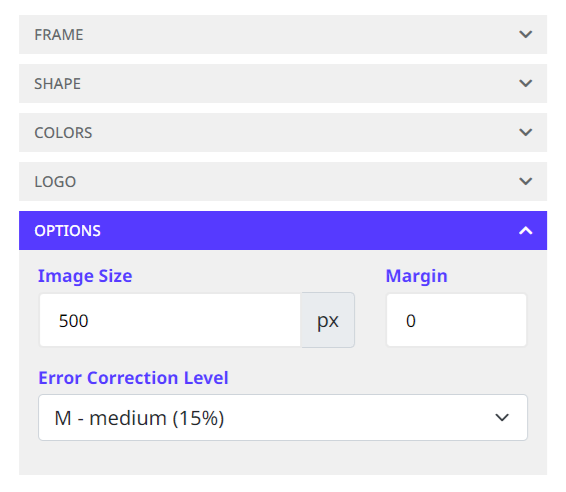
To make your QR code look unique, use the customization options. You can add frame, change shape and color, and put custom logo to the QR code. There are various options are available to generate QR codes with custom designs and sizes. Once you're done, click the Generate QR Code button.

If you are satisfied with the QR Code, proceed to download. Download your QR code in high resolution images and different formats (SVG, PNG, JPG, WEBP). You can also print your QR code or save it in a PDF file.
Save QR codes and access them later, create multiple QR codes, QR code statistics and management, and much more.
Create free accountQRNATIVE is one of the most popular online free QR Code Generator with multiple types of QR content options. You can generate QR codes for different types of content and store large amounts of information in the QR code.

Create static and dynamic QR codes online and customize them with your company logo and brand color. Also, get QR code scan statistics and manage QR content after download or print.

Find out which QR Code receives more scans and discover where your most valuable audience comes from.
Sign Up For Free
Sign up with QRNATIVE to create dynamic QR codes that are trackable and customizable from the account panel.
Sign Up for Free